Energy Saving Guide · Your fridge
Your fridge never switches off
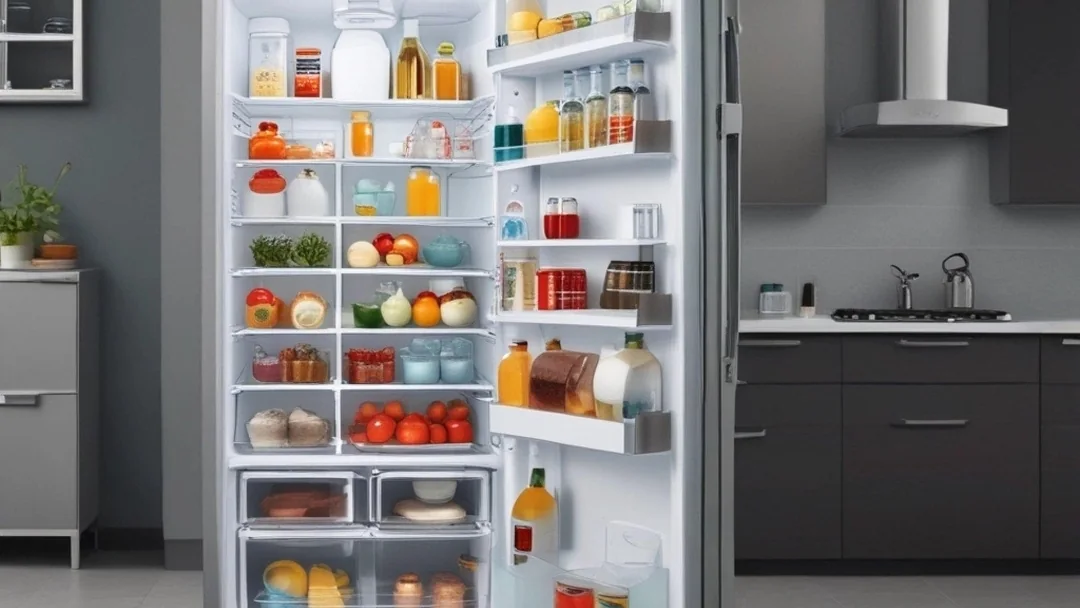
It hums at 3 a.m. It hums while you're at work. Of everything in your kitchen, the fridge is the one appliance that's plugged in 8 760 hours a year.
A fridge doesn't run flat out all the time, but it never stops working. Its compressor cycles on and off around the clock to hold the temperature. The cost depends on three things: how efficient the fridge is, how cold you've set it, and how hard its surroundings make it work. The label tells you the first. Your settings and kitchen control the rest.
The fridge is the only appliance in your house with a 24-hour shift, every day of the year.
Why "never switches off" is mostly true
The compressor switches on and off. The fridge as a whole never does.
A thermostat starts the compressor when the inside warms up and stops it when it's cold enough. Anything that lets heat in or traps heat around the fridge makes those "on" periods longer. That's why a fridge's cost is a property of the whole kitchen, not just the box.
Start with the number on the label
Every new fridge sold in South Africa must carry an energy label, and that label gives you its yearly kWh.
South Africa's compulsory specification VC 9008 covers fridges and freezers, sets minimum efficiency standards, and requires the official energy label. The label's kWh-per-year figure is your best starting estimate. Divide by 12 for a monthly figure, then multiply by your rate.
- A fridge labelled 300 kWh a year uses about 25 kWh a month: roughly R119–R128 a month at Tshwane's top two rates.
- A fridge labelled 600 kWh a year uses about 50 kWh a month: roughly R238–R256 a month.
Real use can be higher than the label in a hot kitchen or with frequent door opening.
The label is a lab number. Your kitchen is not a lab.
The settings most people never check
Too cold costs money and doesn't keep food any safer.
- Temperature. Eskom recommends a fridge at 3–5°C and a freezer at −18°C. A cheap fridge thermometer tells you where yours actually is; the dial numbers don't.
- Fill it, but don't cram it. Eskom says to use only about 90% of capacity so cold air can circulate.
- Defrost. Eskom recommends defrosting a chest freezer twice a year and an upright freezer three times a year. Ice build-up gets in the way of cooling.
Where the fridge lives matters
A fridge pumps heat out of the box and into your kitchen. If the kitchen is hot, it works harder.
Eskom advises keeping fridges and freezers away from sun-facing walls and windows and as far as possible from the stove. On a Highveld summer afternoon, a fridge in direct sun beside the oven is fighting two heat sources at once.
The second fridge question
A second fridge or freezer in the garage doubles the 24-hour shift.
Check its label, or measure it (see the method box). If it's mostly empty, consider whether you need it running all year. If it's old, a measurement will tell you more than its age. A garage in summer is also one of the hottest places to put one.
Interesting things about your fridge
- It's a heat pump. A fridge doesn't make cold; it moves heat from inside to the coils outside. That's why the back or sides feel warm.
- Standby rules don't apply to it the way they do to a TV. VC 9008's standby limits exempt appliances that have no standby or off mode, and a fridge is meant to run continuously.
- The label covers more than fridges. The same specification covers washing machines, tumble dryers, dishwashers, ovens, air conditioners and TVs.
What fixing it could save
These are estimates. Your fridge may be fine.
- Replacing a fridge that measures 50 kWh a month with one labelled 300 kWh a year (25 kWh a month) saves about 25 kWh a month: roughly R119–R128 a month. Measure first: replacing a fridge that's already efficient saves little.
- Switching off an unneeded second fridge saves its whole monthly use. At 25–50 kWh a month, that's roughly R119–R256 a month.
How we worked out these figures
Monthly kWh = label kWh per year ÷ 12. 300 ÷ 12 = 25 kWh; 600 ÷ 12 = 50 kWh.
Measuring instead. Plug the fridge into a plug-in energy meter for a full week, then multiply by about 4.3 for a month. Or read your main meter at the same time on two days with everything else possible switched off (not the freezer for long).
Which rate. A saving comes off your top block. Most Tshwane homes using more than 400 units a month pay R4.75 a unit (401–650) or R5.12 (above 650), including VAT, in 2026/27. So we show savings as a range between those two rates.
Example. 25 kWh × R4.75 = R119; 25 kWh × R5.12 = R128.
(For the seal "paper test" and the gap behind the fridge, see “Why has your bill suddenly increased? Check these 5 appliances first”.)
Safety: don't open your distribution board, plugs or appliance wiring yourself. Electrical work must be done by a registered electrician, who issues a Certificate of Compliance (CoC) for fixed wiring.
Want a second pair of eyes? Lesedi Energy can help you read your meter data and check the electrical side of your home safely. We measure first and recommend only what's needed. Use the contact button on this page to get in touch.
Lesedi Energy: Smarter energy decisions start at home.
Sources (checked 16 Oct 2026)
- Fridge 3°C/5°C, freezer −18°C, 90% fill, defrost frequency, placement away from sun and stove: Eskom Energy Advisory Service, Energy saving tips: https://www.eskom.co.za/eas/energy-saving-tips/ (opens in a new tab) ; Use only what you need: https://www.eskom.co.za/eas/use-only-what-you-need/ (opens in a new tab)
- VC 9008 scope (fridges, freezers and others), MEPS, energy label, standby exemptions: NRCS compulsory specification VC 9008, Notice 7859, GG 55257 (28 Aug 2026), via Acts Online: https://source.acts.co.za/national-regulator-for-compulsory-specifications-act-2008/n7859_4__specific_requirements.php (opens in a new tab) ; original 2014 notice: https://www.gov.za/sites/default/files/gcis_document/201411/38232gon944.pdf (opens in a new tab)
- Tshwane 2026/27 block rates (R4.75 for 401–650 units, R5.12 above 650, incl. VAT; City figures, gazette check pending): City of Tshwane: https://www.tshwane.gov.za/?p=102188 (opens in a new tab)
- All rand figures: calculated (method box above).