Energy Saving Guide · Tariffs
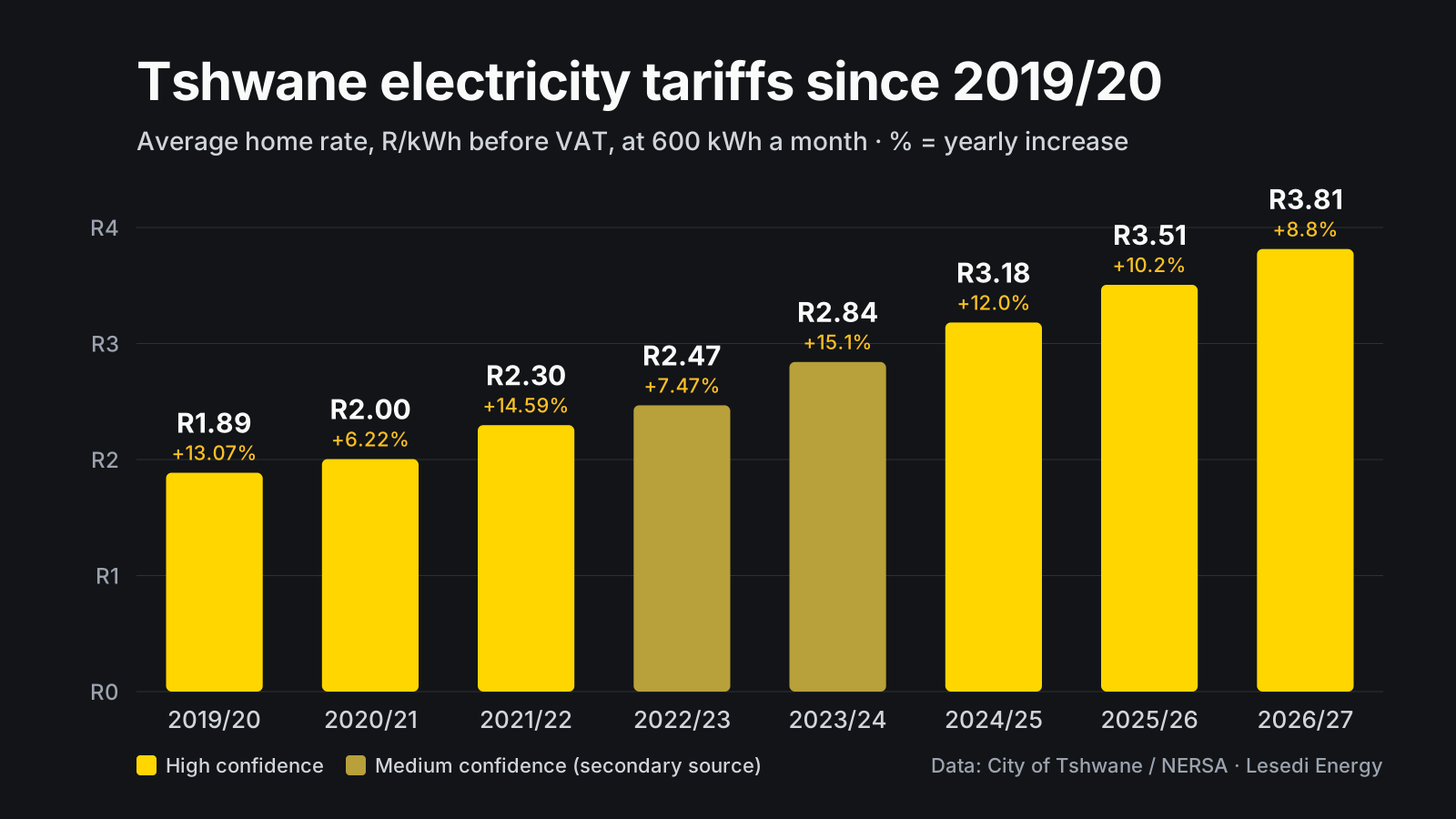
Tshwane electricity tariffs: up about 10.6% a year since 2019/20
You buy the same R1 000 of prepaid units you bought last winter, and the meter runs out a few days sooner. Nothing in the house has changed. The price of a unit has.
If the City of Tshwane supplies your electricity, the energy price of your first block of units has roughly doubled since 2019/20. It has gone up by about 10.6% a year. You can't control the tariff, but you can control which block your last units land in. For most households, that is where the real saving sits.
The price has climbed every year
Each 1 July the City's electricity tariff goes up, and since 2019/20 the rise has never been below 6%.
The first 100 units a month cost 160.31c each in 2019/20. From 1 July 2026 they cost 324.12c. Both figures exclude VAT. Over seven tariff years, that works out to an average of about 10.6% a year.
Some years were gentler than others. The 2020/21 increase was 6.22%. The 2023/24 increase was about 15.1%. The latest, for 2026/27, is 8.8%.
The first 100 units a month cost 160.31c each in 2019/20. From 1 July 2026 they cost 324.12c.
| Tariff year (July–June) | Increase | First 100 units, c/kWh excl. VAT | Note |
|---|---|---|---|
| 2017/18 | 1.8% | — | Low confidence: budget speech only |
| 2018/19 | 6.84% | — | Medium confidence: newspaper report of the budget speech |
| 2019/20 | 13.07% | 160.31 | NERSA |
| 2020/21 | 6.22% | 170.28 | NERSA figures via Parliament |
| 2021/22 | 14.59% | 195.13 | NERSA |
| 2022/23 | about 7.5% | 209.70 | Medium confidence: secondary source |
| 2023/24 | about 15.1% | 241.37 | Medium confidence: secondary source |
| 2024/25 | about 12.0% | 270.33 | Two secondary sources agree |
| 2025/26 | 10.2% | 297.90 | NERSA |
| 2026/27 | 8.8% | 324.12 | City of Tshwane |
Prepaid or conventional, the rate is the same
Tshwane uses one price scale for both prepaid and conventional domestic meters, and there is no monthly fixed charge on it.
You pay only for the units you use. The scale has four blocks, and each block costs more than the one before:
| Units in a month | 2026/27, c/kWh excl. VAT | Per unit incl. 15% VAT |
|---|---|---|
| 0–100 | 324.12 | R3.73 |
| 101–400 | 379.32 | R4.36 |
| 401–650 | 413.27 | R4.75 |
| Above 650 | 445.51 | R5.12 |
Registered indigent households have their own slightly cheaper scale. Big homes on three-phase demand supply, and bulk complexes, use different scales too.
What a month costs now
At 600 units a month, a City-supplied home pays about R2 632 including VAT in 2026/27. The same 600 units cost about R2 419 a year earlier.
That's about R213 more a month for exactly the same use.
| Units a month | 2025/26 incl. VAT | 2026/27 incl. VAT |
|---|---|---|
| 350 | R1 344.92 | R1 463.28 |
| 600 | R2 419.02 | R2 631.91 |
| 900 | R3 814.69 | R4 150.38 |
| 1 200 | R5 227.39 | R5 687.39 |
These figures cover energy only, because there is no fixed charge to add.
Your most expensive units are your last ones
Because the blocks step up, each unit you cut comes off the top of the bill, at your highest rate.
Take a home on 600 units a month in 2026/27 that brings it down to 500. Those 100 units come out of the 401–650 block, at about R4.75 each including VAT. The saving is about R475 a month. That's around R5 700 over a year at today's prices.
Each unit you cut comes off the top of the bill, at your highest rate.
Not on the City's supply? This doesn't apply
If Eskom supplies your home directly, you pay Eskom's residential tariffs, not the City's.
Eskom changes its tariffs on a different date and by different amounts. Check your municipal account or prepaid token slip to see who your supplier is. If it says Eskom, these numbers are not yours.
How the 10.6% figure and the bills were worked out
Growth rate. The compound annual growth rate (CAGR) is (end price ÷ start price)^(1 ÷ years) − 1. For the first block, that's (324.12 ÷ 160.31)^(1/7) − 1 = 10.58% a year, from 2019/20 to 2026/27. All four blocks rose by the same percentage each year, so the rate is the same for every block. Both end points come from high-confidence sources: the NERSA 2019/20 tariff book and the City's 2026/27 tariffs.
Bills. Each block is filled in order: 100 units in block 1, the next 300 in block 2, the next 250 in block 3, and the rest in block 4. The total is then multiplied by 1.15 for VAT. For 600 units in 2026/27:
- 100 × 324.12c = R324.12
- 300 × 379.32c = R1 137.96
- 200 × 413.27c = R826.54
- Total excl. VAT: R2 288.62. Incl. VAT: R2 631.91.
Saving. The saving is the bill before minus the bill after: R2 631.91 − R2 156.65 = R475.26 a month for 600 → 500 units.
Confidence. The early years (2017/18, 2018/19) only have a published increase, with no block prices. 2022/23 to 2024/25 come from secondary sources that print the NERSA figures, and they agree with each other.
Lesedi Energy: Smarter energy decisions start at home.
Sources (checked 16 Oct 2026)
- 2019/20 blocks and 13.07%: NERSA Gauteng approved tariffs 2019/20, mirror copy: https://mrprepaid.co.za/wp-content/uploads/2021/01/Gauteng-approved-tariffs-2019-201.pdf (opens in a new tab)
- 2020/21 blocks: Parliament written reply NW1823, 27 Aug 2020, with NERSA figures: https://pmg.org.za/committee-question/14465/ (opens in a new tab). 6.22%: https://www.midcity.co.za/city-of-tshwane-tariff-increases/ (opens in a new tab)
- 2021/22: NERSA: https://www.nersa.org.za/files/files/2021/08/GAUTENG-TARIFFS-2021-22-Book2.pdf (opens in a new tab)
- 2022/23–2024/25: https://gridpulse.org.za/tariffs/tshwane-2023-24 (opens in a new tab) (and the 2022-23 and 2024-25 pages); https://www.martinique.co.za/wp-content/uploads/2025/07/250701-City-of-Tshwane-Tariffs.pdf (opens in a new tab)
- 2025/26: NERSA: https://www.nersa.org.za/files/files/2025/09/GautengApprovedtariffs2025_.pdf (opens in a new tab)
- 2026/27: City of Tshwane: https://www.tshwane.gov.za/?p=102188 (opens in a new tab) (no NERSA document with the 2026/27 Tshwane figures could be retrieved; the City reports the schedule as gazetted in the Gauteng Provincial Gazette, June 2026; we have not yet seen the gazette itself)
- 2017/18: https://www.timeslive.co.za/news/south-africa/2017-05-18-new-tshwane-administration-announces-tariff-hikes-for-basic-services-in-its-first-budget/ (opens in a new tab) · 2018/19: https://www.citizen.co.za/news/south-africa/tshwane-tariffs-go-up-but-council-lends-a-hand/ (opens in a new tab)